In ‘Practice of Sustainable Design’, I explored the themes that became the foundation of my Capstone work. Here I discovered the groundwork for the Share Shelf and how existing infrastructure can be rediscovered in new and useful ways. This class encouraged me to design a product based on human experience, rather than assumptions and provided a systems thinking approach that highlighted opportunities.
MCAD Class Description: How do we actively design to create truly sustainable results? In this course students examine this question and apply leading-edge practice methods for innovative sustainable and regenerative design solutions. Recommended for novice and veteran designers and innovators alike, this course explores the theoretical frameworks, green standards, and practice techniques used by leading sustainable designers, thinkers, and architects. The design methods applied in this studio course fit any discipline at any scale, from the smallest object to the most complex system. Through studio projects and exercises, students learn to integrate the theory of sustainable design frameworks into their practices (i.e., systems thinking, life-cycle analysis, material health, green standards, eco-labels, supply chain topics, etc.).
In ‘Capstone Concept Development’, I was able to expand even more on my Share Shelf idea and dive deeper into the ‘Why’ of the project. This idea expanded into it’s online counterpart, 'The Share Space’ and began implementation of the Share Shelf prototype.
MCAD Class Description: In the first of this two-semester sequence, students conduct in-depth research and analysis to develop a sustainable design solution to a real-world problem that they will complete in Part 2. The first deliverable is a proposal that emphasizes defining the problem, determining who else is working on this issue, identifying the target audience that the eventual solution will serve, the stakeholders impacted by the eventual solution, and identifying a set of sustainability principles, strategies and tools to apply to help solve the problem defined. Students start the development of their project and have ideation completed by the end of the semester. The second deliverable is an ideation presentation that sets up the work to be further developed and finalized in the capstone studio course. Students engage in both independent work, work guided by the instructor, and collaborative feedback sessions with their chosen mentor to refine their concepts. Students also develop their web-based portfolio, a review of their work from their whole time in the program.
In this class, I was given real world experience by working with a team of students throughout the semester to redesign a product for a real world client. In this semester, I worked in a team of four to redesign a Under Armor product for sustainable solutions. Only the first page of our project is included here because of NDA restrictions.
MCAD Class Description: How do we design real products for real companies, benefiting customers, the companies themselves, and the rest of the world? And how do we know they are better? This studio course provides tools for sustainable design innovation and metrics to measure success. Students use creative and analytical skills, generating new ideas and 3D CAD renderings and evaluating designs with screening-level life-cycle assessments and two eco-labeling systems (Cradle to Cradle and EPEAT). Green innovation tools taught include systems thinking, energy effectiveness, lightweighting, design for lifetime (repair, recycling, etc.), material choice, biomimicry, and persuasive design. Some assignments are individual and theoretical, but the bulk of the course is spent working in groups, using tools such as message boards and screen-sharing video chats.
In ‘Making the Business Case’ I was able to explore creating a complete business proposal for a sustainable solution. I chose to explore a retail space that combined the idea of thrift (reusing clothing) along with supporting local artists to recycling materials into new pieces. This space would act as a sort of makers space where knowledge can be shared, while still operating under the foundations of a profitable secondhand store.
MCAD Class Description: How do market forces shape the way we live, work, and even play? Students in this course look at business through a designer’s eye to understand the interplay between producers and consumers, governments and people, stockholders and stakeholders, man and the environment, and how all of these factors interconnect and ultimately direct how our products, processes, and systems are created. Students gain an understanding of the implications of their decisions, how to identify risk areas, long-term thinking strategies, and best practices for sustainable business models through weekly exercises, special projects, and the creation of a business plan.
In my ‘Climate Justice’ class, I learned all about how important the conversation around justice is when discussing climate solutions. If justice for the people is not a part of the conversation, often solutions can perpetuate already existing injustices and inadvertently do harm in one area, while also do good in another. Particularly in the Global North where decision making power is often located, effects of those decisions unequally effect the Global South. This creates a major disconnection and injustice in the system, making the path forward difficult to navigate. This class for me highlighted a big picture view that opened my eyes to many important features of sustainable solutions!
MCAD Class Description: There is no climate justice without social justice. How can we use design thinking, community engagement, and storytelling to reimagine how our human systems work and create a sense of good health and wellness? Designing new innovative solutions that tackle local and global issues in a more equitable and just way requires a systems transformation which addresses the unequal burden on certain communities. In addition to solution-based projects and assignments, students will use the United Nations Sustainable Development Goals (SDGs) and its indicators to examine issues of climate change and improvements in human conditions through a final environmental-justice-design project or campaign.
In my ‘Packaging’ class, I learned about all things packaging and got the opportunity to give a package of my choice a sustainable redesign. For this project I chose dog treats! Something that I’ve been buying my whole life. For this redesign, I was able to research, design and implement a new packaging solution that was backed by material choices, recyclability, and disassembly features. I especially enjoyed learning about the different symbols the packaging world uses to label their products as ‘eco-friendly’ what the rules are around these icons and how ‘green-washing’ can be a big problem that confuses consumers.
MCAD Class Description: We handle packages every day and they account for a third of our waste stream. Using the format of a product-repositioning study, students in this course examine the core ideas of consumer perception and market triggers, material selection, environmental impact, and long-term strategic thinking. By the end of this course, students are able to maximize a package's appeal while minimizing environmental impact.
In ‘System’s Thinking’ class, I worked on the foundations of understanding systems. This class was essential to the building blocks on the program. By looking at design solutions through a system’s lens, I was able to easily identify all the parts and potential disconnections of a system. This perspective often highlights ways to intervene that will be the most impactful. In this class I chose the industry of death care and particularly how human composting is becoming a sustainable alternative to traditional cremation or ground burial.
MCAD Class Description: Systems thinking is relational thinking, and in this course, students examine how systemic relations underpin efforts to cultivate a more sustainable world. Students analyze patterns of identity, creativity, and change, and nurture capacities for anticipating, coordinating, and contextualizing. Drawing from a wide range of source materials, numerous voices will inform the research. Course assignments include both mapping exercises, which investigate situational complexities through the use of models, frameworks, and matrices, and reflective practices that attend to experiences which manifest during these explorations.
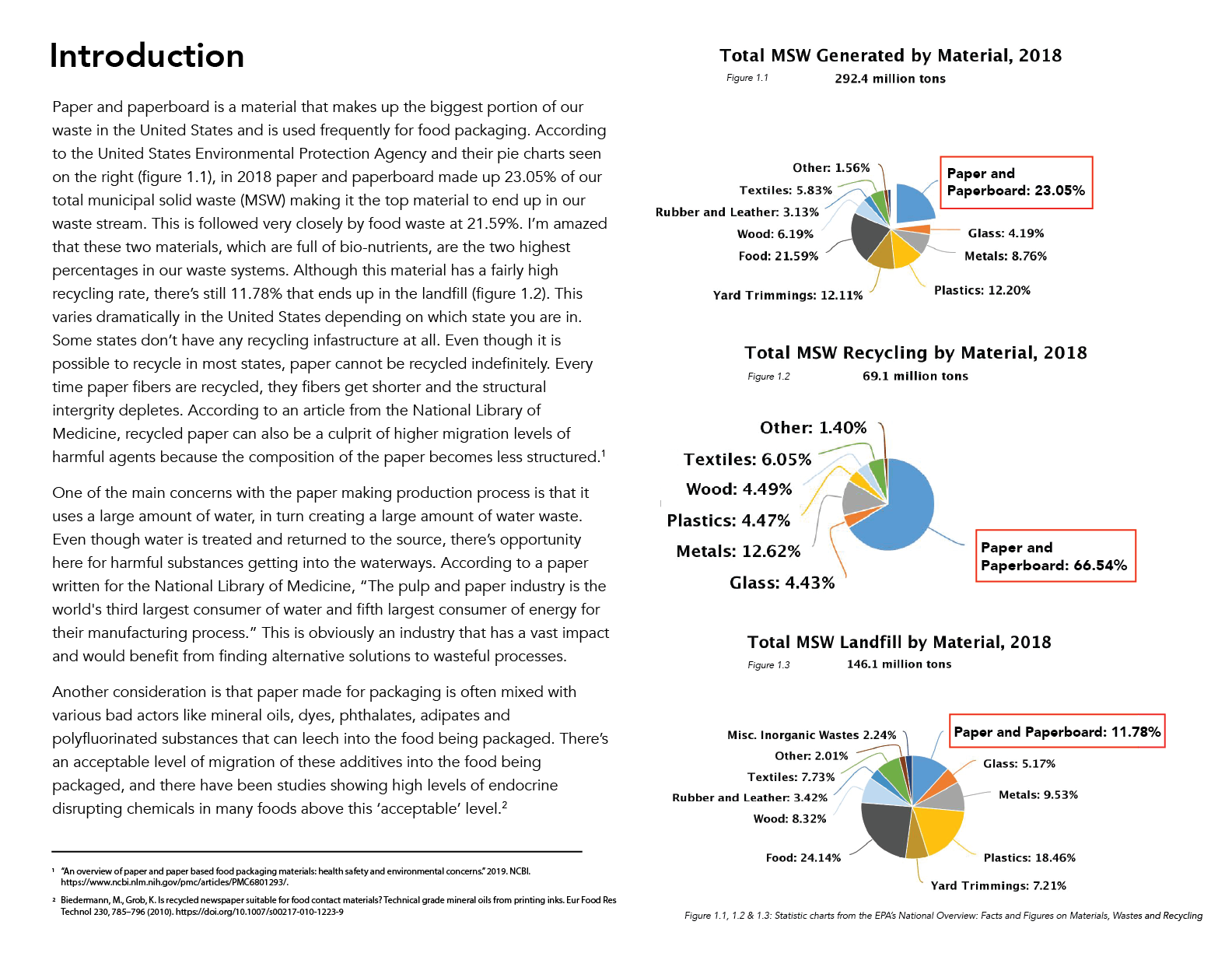
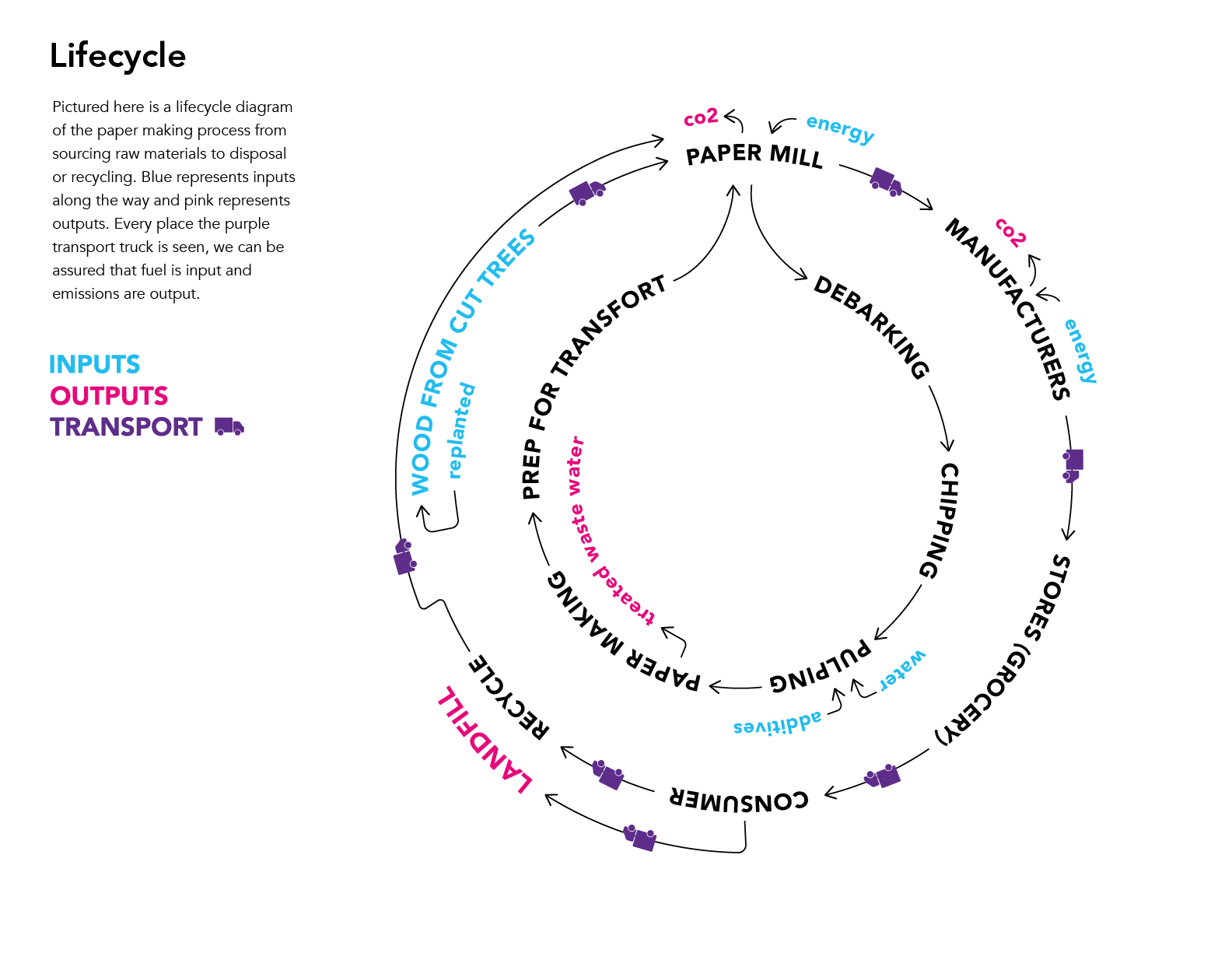
In ‘Fundamentals’, I learned all the basic concepts needed to create a foundation for the rest of the program. This class gave me all the techniques, concepts and tools to dive into the more niche classes that followed. In this class I explored the lifecycle of paper, from extraction to end of life, highlighting the entire process and everything that goes into the production of it.
MCAD Class Description: This foundational course introduces students to sustainability concepts related to business, community, communications, and innovation, as well as covering practical design-for-sustainability (D4S) concepts, strategies, tools and techniques. The universal design-for-sustainability approaches covered in the course are applicable for practicing designers of all disciplines, as well as innovators, marketers and entrepreneurs. Students learn and apply these concepts and strategies to self-directed design projects and exercises in addition to readings, research, lectures, and discussions.